

How a Community Holds Itself
There is a way of living in Bali that is not immediately visible. Not in the architecture, nor in the ceremonies, but in how people relate to one another.
It is shaped quietly, through a shared understanding:
that no one exists on their own.
This is where Asah, Asih, Asuh lives.
Not as a concept, but as a way a community continues to hold itself together.
A Deeper Root: Seeing the Self in Another
At the heart of this way of living is a simple recognition:
Tat Twam Asi — I am you.
Not metaphorically, but as a lived awareness.
To harm another is to disturb something within yourself.
To care for another is to restore balance within the whole.
From this understanding, relationship becomes responsibility.
And from responsibility, a culture begins to take shape.
Three Movements Within One System
Asah, Asih, Asuh are not separate values.
They are three movements within the same field.
Each one completes the other.
Asah
The movement of learning.

Not only in formal spaces, but in everyday exchange —
in conversations,
in shared decisions,
in the quiet passing of knowledge.
It is not about knowing more, but about refining how we see.
Asih
The movement of feeling.

A way of relating that is rooted in care,
in empathy,
in a sense of shared existence.
In Bali, this often takes form as menyama braya —
seeing others as kin, even when they are not.
Asuh
The movement of holding.
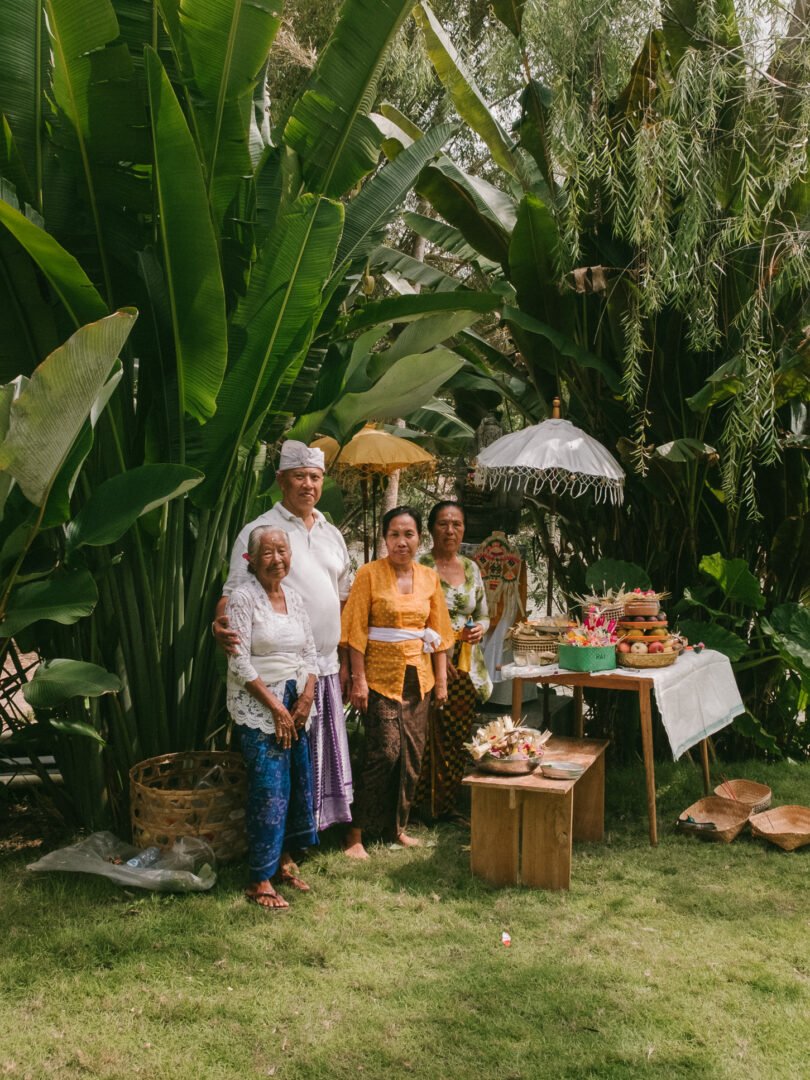
To guide,
to protect,
to ensure that what is vulnerable is not left alone.
It is expressed through responsibility—
toward children,
toward elders,
toward anyone who stands at the edge.
Where It Lives
These values are not abstract.
They are practiced through structures that have existed long before modern systems—
within banjar,
within desa adat,
within the rhythms of collective life.
In these spaces:
decisions are shared,
care is distributed,
and responsibility is rarely individual.
The system holds the person.
And the person sustains the system.
In a Changing Landscape
Today, the context is shifting.
Global influence,
digital life,
and individual pace
begin to reshape how people relate.
The risk is not the change itself—
but the quiet erosion of connection.
When interaction becomes distant,
Asih weakens.
When guidance is absent,
Asuh becomes fragile.
When knowledge is consumed but not integrated,
Asah loses depth.
What Remains
And yet, the foundation is still there.
Not fixed, but adaptable.
Because Asah, Asih, Asuh is not bound to tradition alone—
it is a pattern of living that can move with time,
as long as it is remembered.
In the end, this philosophy is not about preserving something old.
It is about continuing a way of being—
where growth is shared,
care is felt,
and responsibility is held together.